

By Excellence Oseose
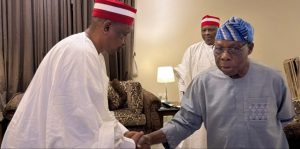
Former President Olusegun Obasanjo’s visit to Kano on Thursday to meet with the Nigeria Democratic Congress (NDC) vice-presidential candidate, Senator Rabiu Musa Kwankwaso, has reignited conversations about the evolving political landscape ahead of the 2027 general elections.
Although the meeting was officially described as a courtesy visit, its timing and the political stature of those involved have sparked widespread speculation about possible opposition realignments aimed at challenging the ruling party in the next electoral cycle.
Obasanjo was received at Kwankwaso’s Kano residence alongside the NDC governorship candidate in the state, Comrade Aminu Abdulsalam Gwarzo. According to Kwankwaso’s media aide, Saifullahi Hassan, the meeting was marked by cordial interactions and warm exchanges. However, no details of the discussions were made public.
The silence surrounding the substance of the meeting has only intensified public interest. In Nigeria’s political environment, private consultations among influential political figures often generate speculation about future alliances, particularly as preparations for national elections gradually gather momentum.
Obasanjo and Kwankwaso share a longstanding political relationship dating back to the former president’s administration between 2003 and 2007, when Kwankwaso served as Nigeria’s Minister of Defence. Their political history has continued to attract attention whenever both leaders engage in high-level consultations.
Beyond their personal relationship, the meeting comes against the backdrop of increasing conversations within opposition circles about the need for greater unity ahead of 2027. Political observers have argued that a fragmented opposition could struggle to mount a formidable challenge unless major political figures find common ground.
The speculation is further strengthened by Obasanjo’s relationship with NDC presidential candidate Peter Obi. The former president openly endorsed Obi during the 2023 presidential election and has remained one of the prominent elder statesmen advocating for credible leadership and good governance.
While neither Obasanjo nor Kwankwaso has suggested that the meeting was connected to coalition talks, analysts believe such engagements provide opportunities for strategic consultations as political parties begin positioning themselves for the next election cycle.
However, it remains too early to draw firm conclusions from the visit. Nigerian politics has witnessed numerous high-profile meetings that generated intense public speculation but ultimately produced little immediate political consequence. Courtesy visits between political leaders are not uncommon and do not necessarily indicate the formation of new alliances.
Nevertheless, with less than a year before major political activities for the 2027 elections are expected to intensify, every interaction involving key political actors is likely to be closely scrutinised.
Whether the Kano meeting represents a simple reunion between longtime associates or the beginning of broader political consultations remains unclear. What is evident, however, is that discussions about coalition-building, opposition cooperation and electoral strategy are gradually taking centre stage as Nigeria moves closer to another defining electoral contest.