


The Federal Government has reaffirmed its commitment to the delivery of the 1,028-kilometre Lagos–Abidjan Corridor, a major regional highway project expected to boost trade and connectivity across West Africa, while raising concerns over design and implementation issues.
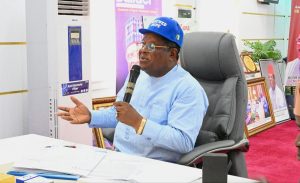
Minister of Works, David Umahi, gave the assurance during a high-level meeting in Abuja with delegations from the ECOWAS Commission and the African Development Bank.
The project, which spans Côte d’Ivoire, Ghana, Togo, Benin, and Nigeria, is designed to connect Abidjan to Lagos, forming a critical transport corridor along the West African coast.
This was contained in a statement on Thursday, by Francis Nwaze, Senior Special Assistant on Media and Publicity to the Minister.
Umahi conveyed the backing of President Bola Ahmed Tinubu, noting that infrastructure development remains central to the administration’s agenda.
He said the Lagos–Abidjan highway would be constructed to match the scale of Nigeria’s ongoing road projects, featuring reinforced concrete pavement and three lanes on each carriageway.
According to the minister, the corridor aligns with broader national infrastructure plans, including the Sokoto–Badagry Superhighway and the Lagos–Calabar Coastal Highway, forming part of an interconnected network aimed at transforming transport and trade across the country and the region.
He disclosed that parts of the Sokoto–Badagry route are already under construction, with the 162-kilometre Badagry section underway, while a 180-kilometre Uyo segment is being prepared for approval by the Federal Executive Council.
Umahi also provided updates on the Lagos–Calabar Coastal Highway, noting that Section One in Lagos has been completed and is scheduled for commissioning in May, while Section Two is expected to reach the Ogun boundary by December. Work, he added, is progressing in Akwa Ibom and Cross River states, with additional sections awaiting approval.
Despite progress, the minister highlighted unresolved issues affecting the Lagos–Abidjan Corridor, particularly concerns over design standards and the unequal distribution of road length among participating countries.
“The distribution of corridor length across countries is unequal and can only be resolved at the level of heads of state,” Umahi said.
He revealed that Nigeria’s portion of the corridor, estimated at about 79.5 kilometres, would be executed to higher specifications than the proposed regional design.
“I am executing mine with reinforced concrete and three lanes, not the two-lane ECOWAS design,” he said, adding that aspects of the regional design were rejected due to inadequate consultation and impractical elements.
Umahi disclosed that Nigeria is developing its own design framework tailored to local realities, expected to be completed within two weeks.
He stressed that key decisions on funding and implementation must be taken at the highest political level before the project can move forward.
“Once the design is finalised and approved by member states, the funding model must be agreed by heads of state. Until then, moving into procurement and financing is premature,” he said.
Earlier, ECOWAS Director of Transport, Chris Appiah, said the visit formed part of ongoing consultations with member states.
He noted that engagements had already taken place with Côte d’Ivoire, Ghana, and Togo, while discussions with Benin are expected to follow recent elections in the country.
On financing, the African Development Bank delegation, led by Salawou Mike Moukaila, described the corridor as a priority project, with strong interest from co-financiers across and beyond Africa.
Moukaila said the bank is currently undertaking an identification mission across 25 countries to develop a financing framework and initiate the first phase of the project.
He emphasised Nigeria’s strategic importance, noting that a significant share of trade along the corridor originates from the country.
The AfDB delegation commended the Nigerian government’s infrastructure drive, describing the Lagos–Abidjan Corridor as a “game changer” for regional integration and economic growth.