




By Becky Momodu
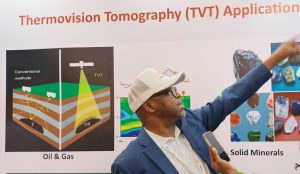
The Chief Executive Officer of Oil Dynamix Limited, Dr. Vincent Amu, has unveiled an innovative mineral exploration technology that he says could transform the mining sector across Nigeria and Africa by significantly reducing exploration timelines, lowering costs and improving accuracy.
Speaking with journalists on the sidelines of the 5th African Natural Resources and Energy Investment Summit (AFNIS 2026), Dr. Amu described the company’s proprietary Thermovision Tomography technology as a breakthrough capable of delivering highly accurate geological data in a fraction of the time required by conventional exploration methods.
According to him, the technology has achieved accuracy levels of between 85 and 95 per cent and has consistently delivered successful outcomes in projects where it has been deployed.
“The biggest takeaway from AFNIS is that we now have a technology capable of unlocking Africa’s vast mineral potential within months rather than years. Every project we have undertaken has produced results, and we have not received any complaints from clients,” he said.
Dr. Amu noted that one of the major barriers to investment in the mining sector is the high cost and uncertainty associated with traditional exploration methods.
He said Thermovision Tomography offers a more affordable and reliable alternative, making the sector more attractive to investors.
“Exploration is often expensive, and inaccurate data can lead to significant losses. Our technology is both cost-effective and highly accurate, which can encourage greater participation in the mining industry,” he stated.
The Oil Dynamix CEO revealed that the technology has already been deployed in several countries and that the company is expanding its operations across Africa.
“We are currently active in Nigeria and have demonstrated results in multiple locations. We are also preparing to map the entire territory of Botswana within one or two months—a task that could take conventional operators up to a decade to complete,” he said.
He explained that the technology provides detailed information on mineral deposits, including their quality, estimated volume and precise geographical coordinates, thereby reducing uncertainty and investment risks.
Reflecting on a recent visit to a lithium mining site, Dr. Amu observed that many operators still rely on traditional exploration techniques, which he described as slow, costly and less efficient.
“While they are making efforts, technology has advanced significantly. What may take conventional methods two years to accomplish can be achieved in a single day using advanced systems, with comprehensive results available within a few months. Time saved translates directly into money saved,” he said.
He emphasized that poor-quality geological data has historically discouraged investment in mining, citing cases where companies failed to locate expected mineral deposits or discovered quantities far below projections.
“Many mining companies have suffered losses because they relied on inaccurate information. Reliable data improves recovery rates, reduces investment risks and increases investor confidence,” he added.
Dr. Amu called on the Federal Government to introduce incentives aimed at supporting indigenous mining companies and accelerating growth in the sector.
Among the measures he recommended are duty-free importation of mining equipment, tax holidays for emerging mining firms and streamlined licensing procedures.
“Import duties significantly increase the cost of mining operations.
Countries such as the Democratic Republic of Congo have adopted supportive policies for the sector. Nigeria can implement similar measures to help local mining companies compete and grow,” he said.
He also urged government agencies and industry stakeholders to embrace emerging technologies that can improve operational efficiency, enhance security and deliver better exploration outcomes.
According to him, Thermovision Tomography differs from conventional exploration techniques by relying on thermal signatures emitted by mineral deposits and captured through satellite systems, including Landsat and MODIS, rather than seismic waves or electrical signals.
Introduced into the Nigerian market in 2019, the technology has continued to attract interest from both public and private sector stakeholders.
Dr. Amu disclosed that several states, including Cross River, Nasarawa, Kaduna, Katsina, Benue and Kogi, have expressed interest in deploying the technology to support mineral resource development.
He expressed confidence that wider adoption of advanced exploration technologies would unlock Nigeria’s vast mineral wealth, attract greater investment and strengthen the country’s position as a leading mining destination in Africa.