

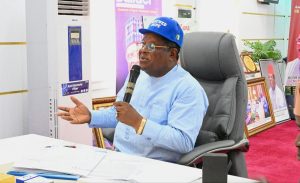
The Minister of Works, Senator David Umahi, has stated that President Bola Ahmed Tinubu’s signature highway projects are progressing steadily across the country, describing them as transformative infrastructure that will redefine transportation, economic growth and national integration.
Speaking at a media briefing in Abuja on Wednesday, Umahi gave a comprehensive update on the administration’s four legacy road projects, saying construction was advancing on multiple sections of the Lagos-Calabar Coastal Highway, the Sokoto-Badagry Super Highway, the Trans-Sahara Highway and the Akwanga–Jos–Bauchi–Gombe–Maiduguri corridor.
The Minister said the Lagos-Calabar Coastal Highway, officially named the President Bola Ahmed Tinubu Coastal Highway, was conceived by Tinubu nearly three decades ago while serving as Governor of Lagos State.
“It is one thing to dream and another thing to have the grace of God to actualise that dream. This is one man that dreams and has the divine mandate to make those dreams a reality,” Umahi said.
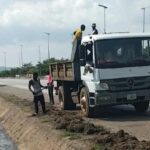
He disclosed that the first section of the coastal highway was progressing rapidly, while the second section linking Lagos and Ogun States was about 60 per cent complete and expected to be substantially delivered before the end of the year, apart from major bridge works.
According to him, work is also advancing on other sections in Cross River, Akwa Ibom, Ogun and Ondo States.
Umahi also announced that President Tinubu had approved the expansion of the fourth legacy project by an additional 400 kilometres, bringing the corridor to about 1,100 kilometres.
He said the extension would link Plateau, Bauchi, Taraba and other parts of the North-East, while approval had also been granted for the completion of the long-abandoned Imbi Bridge in Taraba State and the construction of the Lao Bridge.
The Minister further disclosed that the President approved new highway projects in the South-East, including the Oba–Nnewi–Okigwe Junction road and the Otuocha–Anam–Ibaji route connecting Anambra and Kogi States.
Umahi said the administration’s vision was to interconnect all six geopolitical zones through modern dual carriageways fitted with solar-powered street lighting, closed-circuit television (CCTV), tree planting, emergency response centres and highway patrol facilities.
According to him, the integrated road network would significantly reduce travel time, strengthen national security, promote tourism and facilitate trade across the country.
He also revealed that the Federal Government had approved the reconstruction of the Lagos-Ibadan Expressway using reinforced concrete pavement expected to last between 50 and 100 years with minimal maintenance, alongside the dualisation of about 400 kilometres of the East-West Road corridor.
The Minister maintained that sustained investment in road infrastructure remained essential to Nigeria’s economic development, noting that improved connectivity would stimulate commerce, enhance security and deepen national unity.
“Road infrastructure is the catalyst for economic growth. When roads are connected, businesses flourish, security improves, and the unity of the nation is strengthened,” Umahi said.
He added that emergency response centres, dedicated highway patrol teams and technology-driven monitoring systems would be deployed along the major corridors to improve safety and reduce response time to incidents on federal highways.