
By Becky Momodu
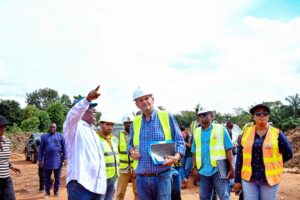
The Minister of Works, David Umahi, has directed contractors handling the Calabar-Abuja Superhighway to avoid demolishing or touching any building along the current alignment until the Federal Government completes a review and, where necessary, realigns the route.
Umahi gave the directive during an inspection of Phase Two of the Calabar-Abuja Superhighway at Ado in Benue State, where he also ordered contractors to accelerate work on the 173-kilometre section valued at N683 billion.
The minister said Section One of the project is valued at N454 billion, while the contractor handling Section Two had already opened the first element of the first eight kilometres.
He directed the contractor to open at least three sections of the first element simultaneously to speed up construction, while efforts continue to resolve the engineering challenges around the Ado Bridge.
“I do not believe in engineering that anything is impossible,” Umahi said, directing the contractor to open another section from the Ado River while engineers work on the best solution for the bridge.
He also said he would personally engage the project manager to determine the technical and practical steps required to keep construction moving.
The minister commended the contractor for the progress recorded since his previous inspection, saying, “From the last time we were here until now, he has done very well, and I’m very proud of what he’s doing.”
On buildings located within the current road alignment, Umahi said the government would prioritise the protection of affected structures pending a review of the route.
“My directive is that no building should be touched. Even if it’s within the alignment, I have to come and realign it. So you just have to continue your work and go around those buildings until we come to look at it,” he said.
Umahi also directed that sharp curves along the highway be strengthened, stressing that engineering realities on major projects could require adjustments to the original design.
He explained that the project was being executed under an EPC Plus Finance arrangement, which does not provide for variations, making careful management of quantities and resources necessary.
The minister said additional works were also being undertaken under Section One, including the dualisation of the road at Onueke and the dualisation at Chainage 0 around Ndibe Beach.
Umahi subsequently defended the Federal Government’s infrastructure programme under President Bola Ahmed Tinubu, rejecting claims that he had concentrated federal projects in the Southeast.
“I saw on social media where they say I cornered all projects to Southeast. That is very wonderful. But we have the publication of all projects ongoing by President Bola Ahmed Tinubu, so they darken counsel without knowledge,” he said.
He stressed that the infrastructure programme was the President’s broader national development agenda and not his personal initiative.
“I’m not on my own. The President is my boss. So where will he be when I corner all projects to Southeast?” Umahi asked.
The minister also dismissed suggestions of a political “rainbow coalition” in Ebonyi State involving him and former Rivers State Governor Nyesom Wike, insisting that the state remained aligned with the All Progressives Congress.
“If Wike has candidates here, he has not told me. And his candidate cannot break our relationship, but his candidate is not part of our relationship,” he said.
Umahi said political opponents were free to campaign in Ebonyi, but warned against hate speech or attempts to cause crisis in the state.
“Nobody can foment crisis in Ebonyi State,” he said.
He further defended the Tinubu administration’s infrastructure projects, urging Nigerians to assess the government based on projects being executed rather than campaign promises.
The minister cited the Ebonyi State ring road as an example, recalling that the state borrowed $150 million to construct 199 kilometres of the road during his tenure as governor.
He said the four legacy infrastructure projects of the Tinubu administration were being financed through a combination of Federal Government and foreign financing, with 30 per cent funded in naira by the Federal Government and 70 per cent through foreign financing.
Umahi also defended his criticism of former Anambra State Governor Peter Obi, saying his concerns centred on policy, political messaging and the use of ethnic sentiments in political discourse.
On the 2027 presidential election, the minister reaffirmed his support for President Tinubu, citing his belief in the President’s vision and reforms.
“What gave rise is because I believe in President Bola Tinubu. I believe that he’s the one called of God. I believe in his vision. I believe in his reforms,” Umahi said.
He also argued that continuity was important for major infrastructure projects because changes in government could affect projects requiring several years to complete.
Umahi further addressed the nomination of his son as Chairman of Ohaozara Local Government Area, clarifying that the nomination was made by Ebonyi State Governor Francis Nwifuru.
He said he had advised his son to ensure transparency and equitable distribution of development across all 11 wards in the council, rather than favouring their home community.
The minister maintained that the Federal Government’s ongoing infrastructure programme would deliver lasting economic value and urged Nigerians to compare existing projects and achievements with previous records.