


By Hosanna Eseose
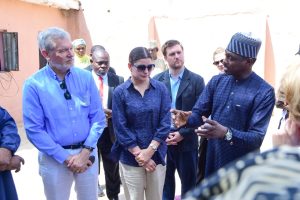
A delegation of European diplomats has visited Kano Film Village to assess the growing impact of Kannywood on youth employment, skills development, economic growth and social transformation across northern Nigeria.
The delegation, led by the European Union Ambassador to Nigeria and ECOWAS, Gautier Mignot, included ambassadors and deputy heads of mission from Denmark, Spain, Italy, France, Czechia, Finland, Belgium and Austria.
During the visit, the diplomats were received by the Executive Secretary of the Kano State Films and Video Censorship Board, Alhaji Abba El-Mustapha, and the Managing Director of the Nigerian Film Corporation, Ali Nuhu.
The delegation met with filmmakers, actors, producers and industry regulators, gaining first-hand insight into the sector’s contributions to job creation and community development. They also observed the production of Hindatu, a film that tells the story of a young girl determined to pursue her education and become a medical doctor despite pressure from her family to marry early.
Speaking during the tour, Ambassador Mignot emphasized the power of storytelling and creative arts in promoting positive social values and behavioural change.
“Stories have the power to inspire change. Films that promote education, opportunity and inclusion can spark important conversations and encourage positive change within communities,” he said.
He noted that the creative industry extends beyond entertainment, serving as a major source of employment, entrepreneurship and skills acquisition for young people.
“Creative industries are not only about culture. They are also about jobs, skills, entrepreneurship and creating opportunities for young people. Across Nigeria, young people are demonstrating remarkable talent and creativity, and industries such as Kannywood are helping transform that potential into livelihoods and economic opportunity,” Mignot added.
Alhaji Abba El-Mustapha highlighted Kannywood’s role in promoting positive social values while creating economic opportunities for thousands of practitioners within the creative sector. He disclosed that the Kano State Films and Video Censorship Board has approved more than 10,000 films over the years and continues to support the industry through training programmes, workshops and stakeholder engagement.
“Our role is not only regulatory. We also work with filmmakers to strengthen professional standards, support capacity development and ensure that films contribute positively to society,” he said.
The delegation also toured Kano Film Village, a production facility established by broadcaster and filmmaker Abdullaziz Dansmall. The facility provides filmmakers with a dedicated environment for efficient film production.
Dansmall explained that the project was developed gradually using revenue generated from film productions.
“Our first major production was Gidang Haya. We used the revenue from that project to build little by little, expanding the facility over time. Our long-term ambition is to transform the site into a fully developed film village capable of supporting larger productions,” he said.
Managing Director of the Nigerian Film Corporation, Ali Nuhu, underscored the industry’s economic importance, citing research that identified film production as the second-largest source of youth employment in Kano State after agriculture.
According to him, the industry’s influence goes beyond entertainment, supporting livelihoods and businesses across the entire value chain. He also pointed to ongoing challenges, particularly in film distribution and access to production infrastructure, while noting that the industry has increasingly embraced digital platforms as traditional DVD markets continue to decline.
The visit comes as the European Union expands cultural cooperation between Africa and Europe through initiatives such as the Africa-Europe Partnerships for Culture (AEPC), a €30 million programme designed to support artist mobility, cultural spaces and collaboration between African and European creative professionals.
The initiative reflects the EU’s growing recognition of culture and creative industries as key drivers of economic opportunity, innovation and social development across the continent.