

By Becky Momodu
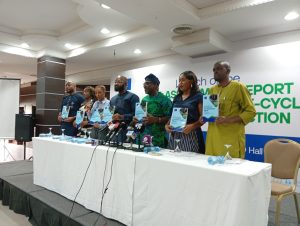
Civil society organisations under the European Union Support to Democratic Governance in Nigeria Phase Two (EU-SDGN II) programme on Thursday launched a pre-election assessment report on the forthcoming Ekiti State off-cycle governorship election, warning of major structural and operational concerns ahead of the June 20, 2026 poll.
The report was presented on Thursday during a media briefing held at Abuja Continental Hotel by members of the Election Observation Hub, a coalition of civil society organisations working to promote transparent, peaceful, credible and inclusive elections in Nigeria.
The coalition said the Ekiti governorship election would serve as the first major test of the Electoral Act 2026 and a dress rehearsal for the 2027 General Election.
According to the report, the election will test the implementation of critical provisions of the new Electoral Act, including electronic transmission of results, administrative review of election outcomes and results collation procedures.
The civil society groups noted that the election was significant because it comes barely seven months before the 2027 general elections, stressing that any failure in Ekiti could create a dangerous precedent for subsequent elections, particularly the Osun governorship poll and the nationwide elections.
The report identified what it described as a “peaceful but uncompetitive” political environment in the state, warning that calmness should not be mistaken for democratic health.
It stated that the election was widely perceived as lacking strong competition due to the advantages of incumbency, elite political consensus around the sitting governor, financial imbalance between the ruling and opposition parties and internal crises within opposition platforms.
The coalition also raised concerns over the preparedness of the Independent National Electoral Commission (INEC), disclosing that election readiness across the 16 local government offices in Ekiti stood at 34 per cent as of April 14, 2026.
It explained that although activities such as Continuous Voter Registration, BVAS inventory checks, network mapping and stakeholder engagements were ongoing, the electoral body was yet to receive election funding while several offices, operational vehicles and collation centres required urgent rehabilitation.
“With 36 days to polling day, a one-third preparedness rate is structurally incompatible with the conduct of a credible election on current trajectory,” the report stated.
The groups further identified Ado-Ekiti, Ikole, Moba and Ilejemeje local government areas as high-risk zones due to threats of urban violence, kidnapping exposure, vote buying, political thuggery, disinformation and possible militarisation of election security.
On security arrangements, the report disclosed that the Nigeria Police Force had proposed the deployment of 9,780 officers, 25 units of mobile policemen, 200 patrol vehicles, 12 Armoured Personnel Carriers and three helicopters under Operation Order 08/2026.
However, the coalition warned against possible politicisation, excessive use of force and perceived bias by security agencies during the election.
The report also highlighted challenges facing the media, including intimidation of journalists, legal harassment and self-censorship driven by economic vulnerability.
It criticised the N5 million campaign signage levy imposed by the Ekiti State Signage and Advertisement Agency, saying the measure disproportionately affected opposition parties.
On inclusion, the civil society organisations lamented that none of the 13 political parties fielded a female governorship candidate, despite existing gender and disability protection laws in the state.
The coalition called on INEC to urgently release and effectively utilise election funds, strengthen the BVAS and IReV systems, intensify voter education and improve accessibility for vulnerable groups.
It also urged political parties to embrace issue-based campaigns, reject vote buying and violence, while calling on journalists to uphold ethical reporting and strengthen fact-checking mechanisms to counter misinformation.
The report was signed on behalf of the Election Observation Hub by the Centre for Media and Society (CEMESO), ElectHER, International Press Centre (IPC), Nigerian Women Trust Fund (NWTF), TAF Africa, The Kukah Centre and Yiaga Africa.