





…says NASS now a mere rubber stamp of executive arm of govt, judiciary in limbo
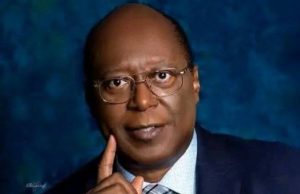
The National Legal Adviser of the ADC and former governor of Edo State, Senator Oserheimen Osunbor has said the Rule of Law now in Nigeria merely exists on paper.
Osunbor a Professor of Law and a two term member of the Senate made this assertion at a one-day Colloquium entitled :The Rule of Law In Contemporary Nigeria: An Indepth Analysis in commemoration of the 90th birthday anniversary of Chief (Barr.) Oladipo Jimilehin, at the Nigerian Institute of International Affairs Lagos, on Thursday.
The past Senator who is also a Rhodes Scholar did justice to the topic tracing where the decay started and how Nigeria has fared in the practice of the Rule of Law.
Drawing references from various studies, Osunbor dug deeply into where the rot began but with emphasis on recent developments from 1999 till date after a careful analysis of earlier years.
Hear him:
“Even under the military, the rule of law was respected and upheld including occasions when doing so challenged the draconian nature of military dictatorship.
Sadly, however, we have now reached a point in Nigeria under the current political leadership where the rule of law exists only on paper. While paying lip service to it and pretending to respect it, the leadership of the three arms of government have not demonstrated fidelity to the concept.
This is a marked departure from the rule of law in Nigeria as we used to know it. I will now proceed to cite well-publicised instances where each arm of government has desecrated the rule of law, exhibiting flagrant disregard that has assumed a sickening and disturbing dimension.The Legislature Nigerians are familiar with several instances in the past when the National Assembly asserted its independence from the executive and serving as a check on the executive.
For instance, under President Olusegun Obasanjo, the National Assembly asserted its right to freely elect their presiding officers – The Senate President and Speaker of the House of Representatives. This also happened with the election of Senate President Bukola Saraki under President Muhammadu Buhari. When President Obasanjo vetoed the NDDC Bill 2000 and the Electoral Bill 2002, the National Assembly overrode the vetoes.
Senate declined to confirm some ministerial appointments made by Obasanjo in the exercise of its powers under the Constitution.
Sadly, the National Assembly now has ceased to exercise its independence. Even by the assessment of some of its members, it has become a mere rubber-stamp that approves every request submitted to it by the President.
This has given rise to embarrassing sundry anomalies like a certificate forger being confirmed as a Minister and the country running two budgets – The Appropriation Acts of 2024 and 2025 – simultaneously, among many other infractions. On 25 February 2023, Nigerians turned out to vote in National elections for the positions of President, Senator and Member of the House of Representatives for the various constituencies. Regrettably, Senators and Members of the House of Representative have abandoned the mandates given to them by their constituents in those elections and now proudly proclaim in song and dance that they stand on the President’s own mandate. This is shameful to say the least, and a huge betrayal of the trust given to these representatives by Nigerians. To be sure, not all members have caved in but they have been threatened to either support the President and whatever he requests or keep silent, in their own interest. (See Senator Eyinaya Abaribe’s remarks published in politicsnigeria.com; 26 Nov 2025).By far the most disturbing betrayal of the rule of law is legislators’ confirmation of the declaration of a State of Emergency in Rivers State by voice vote rather than a vote count. In National Assembly v President [2003] 9 NWLR (Pt. 824) 104, the Court of Appeal decided that a question proposed for decision in the Senate or House of Representatives shall be determined by the required majority of members present and voting.
“For the Rivers case, it was not even clear that a quorum had been formed because, in the House of Representatives, the Speaker ruled that the number of members present and sitting would be known later from the signatures in the register of members which may differ from the number present when the voice vote was taken.Furthermore, the National Assembly violated the provisions of section 11 of the Constitution, in particular, subsection (4) which expressly precludes the National Assembly from removing the Governor or Deputy Governor of a State from office.
“Such acts of impunity by the legislature are clearly a violation of the rule of law. In the past, a State of Emergency was declared in some States without the Governors being suspended.
“The Executive.At the inauguration of the 10th National Assembly in 2023, the President, Bola Ahmed Tinubu, made it known that his choice of Presiding officers were Senator Godswill Akpabio for Senate President and Hon. Tajudeen Abbas for Speaker of the House of Representatives.
” From that moment, rather than function as an independent and co-equal arm of government, the National Assembly has become subordinated to the executive, approving every request made by the President without legislative scrutiny.
“Most of the members proudly sing that they stand on Mr. President’s mandate, not their own. Dissent is crushed and Senators have their microphones switched off on the orders of the Senate President for not joining in praise singing. For instance, Senator Seriake Dickson, who opposed a motion to commend Mr. President for his handling of security which he described as “ill-timed, insensitive and provocative”, was shut up.
” Having rendered itself subservient, the National Assembly is unable to check or restrain the President from violating the letter and spirit of the Constitution.Whereas section 14(1)(b) of the Constitution provides that “the security and welfare of the people shall be the primary purpose of government” this obligation has been jettisoned and taxation of the citizens has become the primary purpose of this government.
“Government provides neither security for the people, given the worsening insecurity across the country, nor provides for the welfare of citizens who are being taxed out of existence and driven into extreme poverty.President Muhammadu Buhari was criticised for his nepotism but that was child’s play and pales into insignificance compared to what we are witnessing today. It is not merely accidental that the Minister of Petroleum Resources, Minister of Finance, Governor of the Central Bank of Nigeria, Minister of Blue/Marine economy, GMD, NNPC Ltd, Chairman, Federal Inland Revenue Services, Comptroller-General of Customs, Accountant-General of the Federation and the heads of all other MDAs having to do principally with money, are the President’s tribesmen. Rather, it is a deliberate action to subvert section 14(3) of the Constitution which makes it mandatory to reflect the Federal Character of Nigeria in making such appointments in order to promote national unity and to ensure that there is no predominance of persons from a few States or a few ethnic or other sectional groups in government or any of its agencies.
“The suspension of a democratically elected governor of Rivers State Sim Fubara, by the President under the guise of a State of Emergency and approved by the National Assembly, represents the most egregious violation of the Constitution.
“A government that so flagrantly desecrates and disregards the Constitution loses the moral authority to demand obedience from its citizens. It is a harbinger of anarchy. “Might is right” is incompatible with democracy and the rule of law.
“The Judiciary.Earlier on in this address, I referred to decided cases where in the past, the judiciary stood firmly to defend the rule of law, leaving behind them a legacy of integrity and honour which the names of the Justices carry till date.
“This dates back to the military era in the 1960s and 1970s when Lakanmi’s case landmarked the readiness of the judiciary to uphold the rule of law. The Supreme Court upheld its sacred responsibility during the Second Republic, 1979 to 1983.
“Under the current democratic dispensation since 1999, it has not wavered or hesitated to hold government accountable. In fact, the Lagos State government under our current President spearheaded a spate of legal actions against the Federal government by invoking the original jurisdiction of the Supreme Court.
“Those cases were heard swiftly and judgments given against the Federal government in defence of the rule of law. Sadly, that is not the case anymore.When the State of Emergency was declared in Rivers State and the Governor suspended from office in a manner that seemed clearly unlawful and unconstitutional, the PDP Governors instituted an action in the Supreme Court to challenge the Federal Government.
“The six months suspension has since run out and the President has restored the governor to his office. Strangely, the PDP Governors’ suit at the Supreme Court has not yet been listed for hearing, talk less of the court declaring the Federal Government action unconstitutional and a violation of the rule of law.
“Your guess is as good as mine why the Supreme Court has acted this way.On 11 July 2024, Nigerians welcomed with applause the judgment of the Supreme Court declaring that henceforth statutory allocations from the Federation Account to Local Government Councils should be paid directly to the Councils rather than into the States Local Government Joint Account as stipulated by s.162(6) of the Constitution.
“This was hailed as a bold attempt to stop the practice whereby most States governors fail to release the money to their councils but instead misappropriate or divert the money elsewhere and by so doing crippling the effectiveness of Local government administration in Nigeria.
“In fact, the Hon. Attorney-General of the Federation and Minister of Justice was widely celebrated for securing this victory which was received with relief by Nigerians. A couple of months after the judgment, at a gathering of State Governors in Mr President’s Lagos residence, he assured them that Governors were in charge of their States and that he, as President, would not interfere with how they chose to run their States.
“He, in effect, distanced himself from and disowned the Supreme Court judgment. Not surprisingly, the judgment has remained unimplemented till date while illegal deductions of local government funds continue unabated. (Att-Gen of the Federation v Att-Gen of Abia State & Ors SC/CV/343/2024).One of the major innovations introduced by the 1999 Constitution was the establishment of the National Judicial Council (NJC).
“It was introduced to free the judiciary from executive control by state and federal governments, insulate them from politics, ensure merit-based appointments to the judiciary, spell out disciplinary procedure, boost public confidence in their neutrality and generally, guarantee their independence as a separate and co-equal arm of government.
“To further guarantee their independence and stop them from going cap-in-hand to the executive, to beg for the release of funds due to them, the National Assembly, in the First Alteration to the Constitution in 2010, put the NJC (along with INEC and the National Assembly) on a first line charge on the Consolidated Revenue Fund of the Federation (s.6 of the CFRN (First Alteration) Act, 2010, amending s.81 of the Constitution 1999).
” All that good intention is now being destroyed by the Hon. Minister of the Federal Capital Territory who is, allegedly, building and donating houses to judges in Abuja.
“No one is saying that judges do not deserve a good living and, in fact, government recognised this recently by approving a 300% salary increase for them. The concern however, is that whatever benefits are due to judges must be paid to them through the NJC. It should not be a direct gift or favour from the executive as this can be construed as a bribe capable of compromising the judges.
“It will be recalled that Chief M.K.O. Abiola during his trial raised the issue of fair hearing on the ground that Justices of the Supreme Court had received car gifts from government and that he could not receive justice from them.
“The NJC did not exist at that time. Now that the NJC is in existence, any direct gift from the executive to the judiciary can be interpreted as an affront to the rule of law being intended as a quid pro quo to compromise the judges.Recently, I came across an article published online by Sylvester Udemezue, titled “Remove The Log In Your Eyes Before Pointing To The Speck In Another’s: A Rejoinder to a Nigeria Supreme Court Justice’s Concern Over Decline Of Legal Knowledge Among Lawyers”, delivered at 2025 edition of the JASA Foundation Legacy dialogue. 2.0 in Abuja (https://therealityministry.ngo, 27 Nov 2025).It was a response to an address delivered by Hon. Justice Emmanuel Agim, JSC, in which he decried the poor standard of some Lawyers. He stated, among others, in the critique, that “A judiciary that cannot guarantee predictability, accountability, transparency or timeliness cannot inspire the confidence necessary for national stability and investment….The judiciary is widely regarded as the soul of every democracy.
“Yet, in Nigeria, it has become the weakest link in the chain of governance”. According to the writer, young lawyers are as much influenced by what they see senior legal practitioners and judges do as what they read in books or were taught by their teachers. Can we truly say that the Supreme Court’s judgments have been inspiring?
” Let me cite three of the Supreme Court judgments with Hon. Justice Agim delivering the lead judgment or agreeing with the majority as a member of the panel.In the recent Supreme Court decision on the Rivers State case (SC/CV/343/2024), (with Hon Emmanuel Agim JSC, delivering the majority judgment) the court upheld the judgment of the trial court that the pro-Fabara PDP Speaker did not produce the APC register at the trial to prove that the 27 pro-Wike members had actually defected from PDP to APC to justify his declaration of their seats vacant in accordance with section 109 of the Constitution. That section provides that a member of a House of Assembly shall vacate his seat if -…..“(g) being a person whose election was sponsored by one political party, he resigns from that political party or he becomes a member of any other political party …” except where his membership of the new political party is as a result of a division in his former party or a merger of 2 or more political parties or factions by one of his previous party.
“The Speaker of the House of Assembly shall give effect” to the Constitution in deciding whether or not a member must vacate his seat. On the basis of that provision of the Constitution, the Supreme Court had in the similar case of Ifedayo Abegunde v Ondo State House of Assembly [2015] 8 NWLR (Pt 1461)314, declared that a member of the Ondo State of Assembly who defected from his party had thereby vacated his seat. In that case, the Courts did not ask or demand to see a party register. In the Rivers case the courts introduced a requirement which is not in the Constitution – that the membership register of a rival political party over which the Speaker had absolutely no control, must be produced by him before he can exercise his powers under section 109(1)(g) and (2).
“There were videos seen by the public of the 27 members waving APC flags as their new party while announcing their defection. The Supreme Court showed no consistency with its earlier judgment under the doctrine of stare decisis and this removes the element of predictability necessary for the rule of law to thrive.
“Courts must not become selective in following judicial precedent or stare decisis. The principle simply means that –“When a point or principle of law has been once officially decided or settled by the ruling of a competent court in a case in which it is directly or necessarily involved, it will no longer be considered as open to examination or to a new ruling by the same tribunal, or by those which are bound to follow its adjudication, unless it be for urgent reasons or exceptional cases”.
” (Black’s Law Dictionary Eighth Edition).Given the similarity between them, it is not clear why the Supreme Court refused to follow Abegunde’s case but instead a 5 member Panel over-ruled the earlier decision of a 7 member panel of the court and read into section 109 of the Constitution what is not there.Much more troubling is the Supreme Court decision in Sunday Jackson v The State (SC/CR/1026/2022), where it upheld, by a majority, the judgments of the lower courts upholding the death sentence on Jackson, the appellant, for killing a herdsman. Jackson was attacked on his farm by a herdsman who stabbed him twice.
“He struggled with the attacker, disarmed him and struck the attacker multiple times, killing him. At his trial, he pleaded self-defence but his defence was rejected on two main grounds, namely, that –After disarming his attacker, he should have run away because there was a “reasonable mode of escape”, and Once Jackson disarmed the attacker, he was no longer in immediate peril and there was no necessity to kill his attacker.
“His act of stabbing the attacker thrice was seen by the courts as “vengeful” rather than a proportionate self-defence reaction.In her well-reasoned dissenting judgment, Hon. Justice Moronkeji Ogunwumiju JSC, said that Jackson should have been acquitted or, at worse, convicted for manslaughter. She noted some critical points, namely,Jackson was first attacked, disarmed his assailant and then used the weapon.
“Jackson’s use of force was justified because he was under life-threatening attack,he had been stabbed twice (back of head and leg) and it was not reasonable to expect him to pause and calibrate the proportionality of his defensive action. Even running away may not have been safe or practical with him and the attacker alone in the bush; suppose the assailant chased after him and caught up with him again?By this decision the Supreme Court has, in effect, removed self-defence from our criminal law.
“The law on self-defence does not make it mandatory that a person under a life-threatening attack should run away. If he runs away the need to plead self-defence would never arise. If he stands his ground and kills his attacker, he commits the offence of murder. This cannot be right.
“This decision has drawn condemnation in Nigeria and from the international community just like other decisions which have cast our judiciary in bad light before the world. Many concerned persons, including Ogunwumiju JSC, have pleaded that the death sentence should be commuted by the State in exercise of the prerogative of mercy.
“Not surprisingly, many foreign courts are increasingly assuming jurisdiction to entertain cases which, ordinarily, fall within the jurisdiction of Nigerian Courts. Their reason for this is that the plaintiffs cannot get justice in Nigerian courts because our judicial system has become unreliable and subject to political interference or other external influence.In Akeredolu v Jegede (SC/448/2021), Hon. Justice Agim JSC; delivering the majority judgment, upheld the election of Governor Akeredolu.
“The petitioner, Jegede, had claimed that Akeredolu’s nomination as APC governorship candidate was forwarded to INEC by Yobe State Governor Mai Mala Buni as APC Caretaker Committee Chairman and was invalid as the Governor acted in violation of section 183 of the Constitution.
“That section provides that a “governor shall not, during his tenure of office, hold any other executive office or paid employment in any capacity whatsoever.” The appeal was dismissed by the Supreme Court on many grounds, among them; because “Political parties are voluntary associations.
“The court cannot inquire into their internal affairs, including the appointment of temporary officers, unless a violation of the Constitution or a Statute is shown”. The appointment of Governor Buni, the court declared, was temporary, non-executive and not executive as contemplated by sections 183 of the Constitution.Another female Justice of the Supreme Court, Hon. Justice Mary Peter-Odili, JSC in her minority decision held that Akeredolu’s election should have been nullified. According to her “The appointment of Governor M.M. Buni, a sitting governor of Yobe State, as Chairman of the APC Caretaker and Extraordinary Convention Planning Committee violated section 183 of the Constitution which says a sitting governor shall not hold any other executive office.
“The position of Buni involved executive function, e.g. signing nomination papers, taking binding decisions on behalf of the party and overseeing the party’s structure nationwide….When a political party violates the Constitution of the Federal Republic of Nigeria, the courts cannot fold their arms under the excuse of “internal affairs”.The majority decision can be faulted on additional grounds.
“To state that Buni was not an executive Chairman because his appointment was temporary and in an acting capacity runs contrary to law. By virtue of the Interpretation Act (section 10(2)), a person serving in an acting capacity has the same status and enjoys all the powers and privileges as a substantive holder of the office. To say that Buni’s appointment was only temporary misses the point because, nobody ever truly remains in office permanently, not even “Permanent Secretaries”. In Oluwatobi v Governor of Oyo State (1984) 5 NCLR 465, it was held that an acting appointment confers full authority to perform the functions of an office, unless there is an express exclusion of such powers.Furthermore, it is not true to say that internal disputes in voluntary associations are not justiciable.
“We all know that internal disputes in voluntary business associations like registered companies, religious bodies, social clubs and associations are justiciable and the law reports are replete with such cases involving associations registered under the Companies and Allied Matters Act (CAMA).
“How much more political parties that are registered under the Constitution which is superior to CAMA.The Hon. Justice Bode Rhodes-Vivour in his valedictory address delivered at the Supreme Court upon his retirement on 22 March 2021, remarked that some decisions of the Supreme Court do not make sense to him anymore. He proposed solutions to strengthen judicial institutions and procedure to reduce corruption, respect for the rule of law and access to justice, among others.
“The recent judgments of the Supreme Court, I surmise, will make even less sense to him, and many others, including Sylvester Udemezue, based on his recent scathing article. These criticisms are not meant to disparage, denigrate or disrespect the judiciary. Anyone who cherishes the rule of law must respect the judiciary. However, polite criticism must be encouraged to correct the failings of the judiciary just as judges are free to correct shortcomings amongst lawyers, especially younger ones.
“The apparent deviations from the rule of law by courts is often defended or excused by some who cite the famous remarks of Justice Oliver Wendell Holmes Jr of the U.S. Supreme Court in his 1897 Essay “The Path of the Law”:-According to Holmes, “The prophesies of what the courts will do in fact, and nothing more pretentious, are what I mean by the law”.
“This remark has been paraphrased by the Realist School of Jurisprudence to mean that “The law is what the judge says it is”. Holmes was not justifying judicial disobedience of the rule of law, including statutes and judicial precedent. Nigerian courts have in the past cautioned that judges must not disregard statutes.In Att-Gen of Bendel State v Aideyan (1989) 4 NWLR (Pt 118) 646, the Supreme Court held that courts are bound by statutes as enacted and cannot “read into the law what is not there”.In Att-Gen. of Ondo State v Att-Gen. of the Federation [2002] 9 NWLR (Pt 772) 222, the Supreme Court stated that judicial interpretation must not rewrite the law.
“In Olafishe v Governor of Oyo State [2019], it was declared that courts “cannot disregard clear statutory provisions under the guise of interpretation. Such decisions are erroneous, contrary to the rule of law and subject to reversal on appeal”. But suppose it is the Supreme Court that does this, who do you appeal to? The Supreme Court must be self-correcting and restore public confidence in itself and the entire judicial system that has waned seriously to the extent that the judiciary is now perceived as the weakest arm of government, if not the most corrupt.
“To many Nigerians, “Go To Court” has become a mockery by wrongdoers who have managed to corner the judiciary to do their bidding.ConclusionThe rule of law in Nigeria is under attack on several fronts and is now on the retreat. It faces a grim future unless bold and sincere corrective actions are taken to save it from continued assault. At the All Nigeria Judges Conference held on 17 November 2025 at the National Judicial Institute, Abuja, with the theme “Building a Confident Judiciary”, the Chief Justice of Nigeria, the Hon. Justice Kekere-Ekun in her address acknowledged that judicial decisions in Nigeria are “sometimes vulnerable to external influences”. She admitted “with candour that there are some within our ranks who have undermined the integrity of the bench”. Mr. President in his address admonished the judges – “Do not sell your integrity”. Many in the social media wondered cynically, “Who is the biggest buyer of judicial integrity in Nigeria”? “Is there any integrity left to be bought?” I leave you with your own answers.I cannot finish this address without talking about the role of citizens to uphold and respect the rule of law as it is not a matter that concerns government alone.
Read full address below:
The celebrant, in whose honour we are here gathered today, has lived a life of service to humanity, leveraging on his professional background as a legal practitioner and a politician.
From his early years as a student activist in the United Kingdom in the 1970s, he has concerned himself about using his talents to contribute towards building a better society. Not surprisingly, as he celebrates his 90th birthday today, he has chosen to host this Colloquium to interrogate the rule of law which is essential for the attainment of good governance and a decent society for all.I congratulate him on attaining 90 – an age that belies his looks. It is my prayer that Almighty God will continue to sustain him with continued good health and his youthful looks which is the envy of many younger folks.
I feel highly honoured that he has invited me to deliver this Keynote Address.Introduction: Meaning of the Rule of Law.The rule of law is a topic that has engaged scholars over the ages.
The Greek philosopher, Aristotle, about 2000 BC, postulated that the rule of law is preferable to the rule of man. Here in Nigeria, Nnaemeka-Agu (JSC) asserted that the rule of law implies resort to law and order in the polity in preference to arbitrariness, anarchy, violence, warfare or strife.
It is based on the understanding that society is governed by laws. Accordingly, he said, government must be conducted according to law and in case of doubt or ambiguity, the matter must be resolved by the judiciary. (See “The Position and Role of a Judge in a Democratic State”), Nweze (ed.) Justice in The Judicial Process at p.220.Rule of law is the foundation of every democratic society. In fact, there can be no democracy where rule of law is treated with disdain by the powerful. That would be tantamount to a dictatorship, whether in Khaki of Agbada.There is hardly any concept more analysed and discussed in the affairs of nations and governance than the rule of law and this is true of Nigeria.
It has engaged the scrutiny of scholars across the world and over the ages. There is an abundance of literature and judicial decisions to support it. In this address, I shall examine the rule of law in Nigeria as established by our Constitution and relevant laws and adumbrated by pronouncements of jurists and decisions of courts.
The term Rule of law means that all persons and authorities are subject to the Constitution and the laws of the land and government powers must be exercised in accordance with the law in a fair and rational manner.
It is the cornerstone of Nigeria’s constitutional democracy and a bulwark against arbitrary actions and decisions of government. By so doing, it protects the society from dictatorship while ensuring that power is exercised in accordance with established legal rules.The Foundation of Rule of Law in Nigeria.
“The constitutional foundation of the rule of law in Nigeria is to be found in the very first section of our Constitution which makes the Constitution supreme. Section 1 stipulates as follows.This Constitution is supreme and its provisions shall have binding force on all authorities and persons throughout the Federal Republic of Nigeria.The Federal Republic of Nigeria shall not be governed, nor shall any person or group of persons take control of the Government of Nigeria or any part thereof, except in accordance with the provisions of this Constitution.If any other law is inconsistent with the provisions of this Constitution, this Constitution shall prevail, and that other law shall to the extent of the inconsistency, be void”.Under the Constitution, governmental powers are allocated separately between the three arms of government namely, the Legislature, which is responsible for making laws (s.4); The Executive, which is responsible for maintaining, executing, enforcing and implementing the Constitutions and the laws (s.5); The Judiciary, which is responsible for interpreting the laws and adjudicating disputes(s.6).These provisions underline the separation of powers under our Constitution. In order to avoid a clash with the Judiciary, the Constitution provides that laws made by the legislature are subject to the jurisdiction of courts of law and tribunals established by law.
“Accordingly, the National Assembly and House of Assembly of the States are prohibited from making any law that ousts or purports to oust the jurisdiction of a court or tribunal s.4(8). Within the Nigerian context, this protection of the judicial arm of government was necessary in the light of ouster clauses in military Decrees and Edicts that robbed the courts of jurisdiction to do their work. It is ironical, though, to see courts ousting the jurisdiction of the legislature when they issue orders to stop them from doing their work, a practice that has become rampant. Rather than stop them from performing their functions, the proper recourse is to subject their legislative action to judicial review.
Separation of powers ensures that power is not concentrated in the hands of one person or authority for this will breed tyranny and conflict with the tenets of democracy. One of the earliest proponents of separation of powers is Montesquieu. According to one writer –“The reasons on which Montesquieu grounds his maxim are a further demonstration of his meaning “When the legislative and executive powers are united in the same person or body ……. there can be no liberty, because apprehensions may arise lest the same monarch or senate should enact tyrannical laws to execute them in a tyrannical manner …. Were the power of judging joined with the legislative, the life and liberty of the subject would be exposed to arbitrary control, for the judge would then be the legislator. Were it joined to the executive power, the judge might behave with all the violence of an oppressor”. (Omonuwa and Omoniyi (eds) On Judicial Integrity: Essays in Honour of Hon. Justice S.O. Uwaifo (2014) at p.74).Under our system, the powers, though separate, do not exist in water-tight compartments but, rather, complement one another through the exercise of checks and balances.Thus, the legislature can issue an order of arrest which is an executive function and undertakes hearings which is a quasi-judicial function. The executive exercises legislative function through delegated legislation and a bill does not become an Act or State Law until the President or Governor, as the case may be, gives his assent to it, except where the legislature overrides a veto by the President or Governor.
The Judiciary makes laws in what is regarded as “judge-made law” and judicial precedent.The main responsibility of ensuring that governance is conducted in accordance with the law and the Constitution and enforcing the rule of law is that of the courts. It is an important safeguard for the rule of law over the rule of autocrats and dictators. It is the duty of the judiciary to put the other arms of government in check, avoid arbitrary action and hold them accountable. The main burden of compelling everyone to subject themselves to the rule of law, rests on the judiciary. Rule of Law dies where judges fail to perform this sacred duty.
On them lies the responsibility of ensuring that the rule of law prevails at all times by curtailing impunity and wanton disregard of the law and the Constitution.Key Elements of the Rule of LawThere are eight (8) key elements of the rule of law recognised and boldly upheld by Nigerian courts in the past. They are discussed below with selected supportive decisions to illustrate.Supremacy of the law: No one is above the law, no matter his office or status as the law is supreme even under military rule.
Lakanmi v Att.Gen of Western Region (1971) 1 UILR 201.Equality before the Law: All persons – citizens, public officers and institutions are equal before the law and entitled to equal protection and must obey court orders. Thus in Military Governor of Lagos State v Ojukwu (1986) 2 SC 277, the leading case on the point, the Supreme Court criticised the military government’s use of force to evict Chief Odumegwu Ojukwu from his residence in Queen’s Drive, Ikoyi Lagos, affirming that – “government cannot take the laws into its own hands” and that respect for court orders is fundamental to the rule of law. Obaseki JSC remarked – “In the area where rule of law operates, the rule of self-help is abandoned.
Nigeria being one of the countries which profess loudly to follow the rule of law gives no room to the rule of self-help by force …..”Accountability: Government officials and institutions are accountable for their actions and can be checked through the courts and other legal mechanisms. This principle was also established in Ojukwu’s case.Fairness and Justice: Laws must be applied fairly and justice should be accessible to all, timely and impartial.
This was established in the case of Alhaji Adigun v Att.Gen of Oyo State (1987).Separation of Powers: Governmental powers have been divided among the three arms of government and among each tier of government-federal, states and local government – to prevent abuse and that none should encroach into the province of another. Att-Gen. of Abia State v Att-Gen. of the Federation [2002] 6 NWLR (Pt 763) 264.Legal Certainty: Laws should be clear, publicly known, stable and predictable, not arbitrary or retrogressive. Thus in Shugaba Darman v Minister of Internal Affairs [1981]2 NCLR, 459, where a Nigerian legislator was unlawfully deported, it was held that government must act within the law and actions taken outside legal authority violated the rule of law and fundamental rights.Protection of Fundamental rights: The State must not violate the rule of law and fundamental rights and freedom of its citizens.
This was established in Shugaba’s case.Judicial review of government action: In the case of Attorney-General of Bendel State v Attorney-General of the Federation [1986] 1 NWLR (Pt 18) 621, the National Assembly purported to pass an Appropriation Act which had been approved by the Senate Committee on Appropriation but, in order to avoid possible objection by opposition Senators, was not presented for deliberation and approval by the Senate as a whole in accordance with the procedure for passing a Money Bill.
The Supreme Court declared the Appropriation Act invalid, null and void. The CJN, Fatai-Williams, remarked –“I cannot conceive of a situation in any country with parliamentary democracy where legislative powers generally, and those relating to money bills in particular, could be handed over by the elected representatives of the people to a committee of twenty-four of such elected members, no matter how eminent they may be” (p.634).
An Analysis of the Rule of Law Under the Current Democratic Dispensation.It can be seen from the above analysis of the key elements of the rule of law and supported by decisions of courts, that the rule of law has thrived and been a cardinal principle of governments in Nigeria. Even under the military, the rule of law was respected and upheld including occasions when doing so challenged the draconian nature of military dictatorship.
Sadly, however, we have now reached a point in Nigeria under the current political leadership where the rule of law exists only on paper. While paying lip service to it and pretending to respect it, the leadership of the three arms of government have not demonstrated fidelity to the concept.
This is a marked departure from the rule of law in Nigeria as we used to know it. I will now proceed to cite well-publicised instances where each arm of government has desecrated the rule of law, exhibiting flagrant disregard that has assumed a sickening and disturbing dimension.The Legislature Nigerians are familiar with several instances in the past when the National Assembly asserted its independence from the executive and serving as a check on the executive.
For instance, under President Olusegun Obasanjo, the National Assembly asserted its right to freely elect their presiding officers – The Senate President and Speaker of the House of Representatives. This also happened with the election of Senate President Bukola Saraki under President Muhammadu Buhari. When President Obasanjo vetoed the NDDC Bill 2000 and the Electoral Bill 2002, the National Assembly overrode the vetoes.
Senate declined to confirm some ministerial appointments made by Obasanjo in the exercise of its powers under the Constitution.
Sadly, the National Assembly now has ceased to exercise its independence. Even by the assessment of some of its members, it has become a mere rubber-stamp that approves every request submitted to it by the President.
This has given rise to embarrassing sundry anomalies like a certificate forger being confirmed as a Minister and the country running two budgets – The Appropriation Acts of 2024 and 2025 – simultaneously, among many other infractions. On 25 February 2023, Nigerians turned out to vote in National elections for the positions of President, Senator and Member of the House of Representatives for the various constituencies. Regrettably, Senators and Members of the House of Representative have abandoned the mandates given to them by their constituents in those elections and now proudly proclaim in song and dance that they stand on the President’s own mandate. This is shameful to say the least, and a huge betrayal of the trust given to these representatives by Nigerians. To be sure, not all members have caved in but they have been threatened to either support the President and whatever he requests or keep silent, in their own interest. (See Senator Eyinaya Abaribe’s remarks published in politicsnigeria.com; 26 Nov 2025).By far the most disturbing betrayal of the rule of law is legislators’ confirmation of the declaration of a State of Emergency in Rivers State by voice vote rather than a vote count. In National Assembly v President [2003] 9 NWLR (Pt. 824) 104, the Court of Appeal decided that a question proposed for decision in the Senate or House of Representatives shall be determined by the required majority of members present and voting. For the Rivers case, it was not even clear that a quorum had been formed because, in the House of Representatives, the Speaker ruled that the number of members present and sitting would be known later from the signatures in the register of members which may differ from the number present when the voice vote was taken.Furthermore, the National Assembly violated the provisions of section 11 of the Constitution, in particular, subsection (4) which expressly precludes the National Assembly from removing the Governor or Deputy Governor of a State from office. Such acts of impunity by the legislature are clearly a violation of the rule of law. In the past, a State of Emergency was declared in some States without the Governors being suspended.The Executive.At the inauguration of the 10th National Assembly in 2023, the President, Bola Ahmed Tinubu, made it known that his choice of Presiding officers were Senator Godswill Akpabio for Senate President and Hon. Tajudeen Abbas for Speaker of the House of Representatives. From that moment, rather than function as an independent and co-equal arm of government, the National Assembly has become subordinated to the executive, approving every request made by the President without legislative scrutiny. Most of the members proudly sing that they stand on Mr. President’s mandate, not their own. Dissent is crushed and Senators have their microphones switched off on the orders of the Senate President for not joining in praise singing. For instance, Senator Seriake Dickson, who opposed a motion to commend Mr. President for his handling of security which he described as “ill-timed, insensitive and provocative”, was shut up. Having rendered itself subservient, the National Assembly is unable to check or restrain the President from violating the letter and spirit of the Constitution.Whereas section 14(1)(b) of the Constitution provides that “the security and welfare of the people shall be the primary purpose of government” this obligation has been jettisoned and taxation of the citizens has become the primary purpose of this government. Government provides neither security for the people, given the worsening insecurity across the country, nor provides for the welfare of citizens who are being taxed out of existence and driven into extreme poverty.President Muhammadu Buhari was criticised for his nepotism but that was child’s play and pales into insignificance compared to what we are witnessing today. It is not merely accidental that the Minister of Petroleum Resources, Minister of Finance, Governor of the Central Bank of Nigeria, Minister of Blue/Marine economy, GMD, NNPC Ltd, Chairman, Federal Inland Revenue Services, Comptroller-General of Customs, Accountant-General of the Federation and the heads of all other MDAs having to do principally with money, are the President’s tribesmen. Rather, it is a deliberate action to subvert section 14(3) of the Constitution which makes it mandatory to reflect the Federal Character of Nigeria in making such appointments in order to promote national unity and to ensure that there is no predominance of persons from a few States or a few ethnic or other sectional groups in government or any of its agencies.The suspension of a democratically elected governor of Rivers State Sim Fubara, by the President under the guise of a State of Emergency and approved by the National Assembly, represents the most egregious violation of the Constitution. A government that so flagrantly desecrates and disregards the Constitution loses the moral authority to demand obedience from its citizens. It is a harbinger of anarchy. “Might is right” is incompatible with democracy and the rule of law.The Judiciary.Earlier on in this address, I referred to decided cases where in the past, the judiciary stood firmly to defend the rule of law, leaving behind them a legacy of integrity and honour which the names of the Justices carry till date.
“This dates back to the military era in the 1960s and 1970s when Lakanmi’s case landmarked the readiness of the judiciary to uphold the rule of law. The Supreme Court upheld its sacred responsibility during the Second Republic, 1979 to 1983. Under the current democratic dispensation since 1999, it has not wavered or hesitated to hold government accountable. In fact, the Lagos State government under our current President spearheaded a spate of legal actions against the Federal government by invoking the original jurisdiction of the Supreme Court. Those cases were heard swiftly and judgments given against the Federal government in defence of the rule of law. Sadly, that is not the case anymore.When the State of Emergency was declared in Rivers State and the Governor suspended from office in a manner that seemed clearly unlawful and unconstitutional, the PDP Governors instituted an action in the Supreme Court to challenge the Federal Government. The six months suspension has since run out and the President has restored the governor to his office. Strangely, the PDP Governors’ suit at the Supreme Court has not yet been listed for hearing, talk less of the court declaring the Federal Government action unconstitutional and a violation of the rule of law. Your guess is as good as mine why the Supreme Court has acted this way.On 11 July 2024, Nigerians welcomed with applause the judgment of the Supreme Court declaring that henceforth statutory allocations from the Federation Account to Local Government Councils should be paid directly to the Councils rather than into the States Local Government Joint Account as stipulated by s.162(6) of the Constitution. This was hailed as a bold attempt to stop the practice whereby most States governors fail to release the money to their councils but instead misappropriate or divert the money elsewhere and by so doing crippling the effectiveness of Local government administration in Nigeria. In fact, the Hon. Attorney-General of the Federation and Minister of Justice was widely celebrated for securing this victory which was received with relief by Nigerians. A couple of months after the judgment, at a gathering of State Governors in Mr President’s Lagos residence, he assured them that Governors were in charge of their States and that he, as President, would not interfere with how they chose to run their States. He, in effect, distanced himself from and disowned the Supreme Court judgment. Not surprisingly, the judgment has remained unimplemented till date while illegal deductions of local government funds continue unabated. (Att-Gen of the Federation v Att-Gen of Abia State & Ors SC/CV/343/2024).One of the major innovations introduced by the 1999 Constitution was the establishment of the National Judicial Council (NJC). It was introduced to free the judiciary from executive control by state and federal governments, insulate them from politics, ensure merit-based appointments to the judiciary, spell out disciplinary procedure, boost public confidence in their neutrality and generally, guarantee their independence as a separate and co-equal arm of government. To further guarantee their independence and stop them from going cap-in-hand to the executive, to beg for the release of funds due to them, the National Assembly, in the First Alteration to the Constitution in 2010, put the NJC (along with INEC and the National Assembly) on a first line charge on the Consolidated Revenue Fund of the Federation (s.6 of the CFRN (First Alteration) Act, 2010, amending s.81 of the Constitution 1999). All that good intention is now being destroyed by the Hon. Minister of the Federal Capital Territory who is, allegedly, building and donating houses to judges in Abuja. No one is saying that judges do not deserve a good living and, in fact, government recognised this recently by approving a 300% salary increase for them. The concern however, is that whatever benefits are due to judges must be paid to them through the NJC. It should not be a direct gift or favour from the executive as this can be construed as a bribe capable of compromising the judges. It will be recalled that Chief M.K.O. Abiola during his trial raised the issue of fair hearing on the ground that Justices of the Supreme Court had received car gifts from government and that he could not receive justice from them. The NJC did not exist at that time. Now that the NJC is in existence, any direct gift from the executive to the judiciary can be interpreted as an affront to the rule of law being intended as a quid pro quo to compromise the judges.Recently, I came across an article published online by Sylvester Udemezue, titled “Remove The Log In Your Eyes Before Pointing To The Speck In Another’s: A Rejoinder to a Nigeria Supreme Court Justice’s Concern Over Decline Of Legal Knowledge Among Lawyers”, delivered at 2025 edition of the JASA Foundation Legacy dialogue. 2.0 in Abuja (https://therealityministry.ngo, 27 Nov 2025).It was a response to an address delivered by Hon. Justice Emmanuel Agim, JSC, in which he decried the poor standard of some Lawyers. He stated, among others, in the critique, that “A judiciary that cannot guarantee predictability, accountability, transparency or timeliness cannot inspire the confidence necessary for national stability and investment….The judiciary is widely regarded as the soul of every democracy. Yet, in Nigeria, it has become the weakest link in the chain of governance”. According to the writer, young lawyers are as much influenced by what they see senior legal practitioners and judges do as what they read in books or were taught by their teachers. Can we truly say that the Supreme Court’s judgments have been inspiring? Let me cite three of the Supreme Court judgments with Hon. Justice Agim delivering the lead judgment or agreeing with the majority as a member of the panel.In the recent Supreme Court decision on the Rivers State case (SC/CV/343/2024), (with Hon Emmanuel Agim JSC, delivering the majority judgment) the court upheld the judgment of the trial court that the pro-Fabara PDP Speaker did not produce the APC register at the trial to prove that the 27 pro-Wike members had actually defected from PDP to APC to justify his declaration of their seats vacant in accordance with section 109 of the Constitution. That section provides that a member of a House of Assembly shall vacate his seat if -…..“(g) being a person whose election was sponsored by one political party, he resigns from that political party or he becomes a member of any other political party …” except where his membership of the new political party is as a result of a division in his former party or a merger of 2 or more political parties or factions by one of his previous party. “The Speaker of the House of Assembly shall give effect” to the Constitution in deciding whether or not a member must vacate his seat. On the basis of that provision of the Constitution, the Supreme Court had in the similar case of Ifedayo Abegunde v Ondo State House of Assembly [2015] 8 NWLR (Pt 1461)314, declared that a member of the Ondo State of Assembly who defected from his party had thereby vacated his seat. In that case, the Courts did not ask or demand to see a party register. In the Rivers case the courts introduced a requirement which is not in the Constitution – that the membership register of a rival political party over which the Speaker had absolutely no control, must be produced by him before he can exercise his powers under section 109(1)(g) and (2). There were videos seen by the public of the 27 members waving APC flags as their new party while announcing their defection. The Supreme Court showed no consistency with its earlier judgment under the doctrine of stare decisis and this removes the element of predictability necessary for the rule of law to thrive. Courts must not become selective in following judicial precedent or stare decisis. The principle simply means that –“When a point or principle of law has been once officially decided or settled by the ruling of a competent court in a case in which it is directly or necessarily involved, it will no longer be considered as open to examination or to a new ruling by the same tribunal, or by those which are bound to follow its adjudication, unless it be for urgent reasons or exceptional cases”. (Black’s Law Dictionary Eighth Edition).Given the similarity between them, it is not clear why the Supreme Court refused to follow Abegunde’s case but instead a 5 member Panel over-ruled the earlier decision of a 7 member panel of the court and read into section 109 of the Constitution what is not there.Much more troubling is the Supreme Court decision in Sunday Jackson v The State (SC/CR/1026/2022), where it upheld, by a majority, the judgments of the lower courts upholding the death sentence on Jackson, the appellant, for killing a herdsman. Jackson was attacked on his farm by a herdsman who stabbed him twice. He struggled with the attacker, disarmed him and struck the attacker multiple times, killing him. At his trial, he pleaded self-defence but his defence was rejected on two main grounds, namely, that –After disarming his attacker, he should have run away because there was a “reasonable mode of escape”, and Once Jackson disarmed the attacker, he was no longer in immediate peril and there was no necessity to kill his attacker.His act of stabbing the attacker thrice was seen by the courts as “vengeful” rather than a proportionate self-defence reaction.In her well-reasoned dissenting judgment, Hon. Justice Moronkeji Ogunwumiju JSC, said that Jackson should have been acquitted or, at worse, convicted for manslaughter. She noted some critical points, namely,Jackson was first attacked, disarmed his assailant and then used the weapon.Jackson’s use of force was justified because he was under life-threatening attack,he had been stabbed twice (back of head and leg) and it was not reasonable to expect him to pause and calibrate the proportionality of his defensive action. Even running away may not have been safe or practical with him and the attacker alone in the bush; suppose the assailant chased after him and caught up with him again?By this decision the Supreme Court has, in effect, removed self-defence from our criminal law. The law on self-defence does not make it mandatory that a person under a life-threatening attack should run away. If he runs away the need to plead self-defence would never arise. If he stands his ground and kills his attacker, he commits the offence of murder. This cannot be right.This decision has drawn condemnation in Nigeria and from the international community just like other decisions which have cast our judiciary in bad light before the world. Many concerned persons, including Ogunwumiju JSC, have pleaded that the death sentence should be commuted by the State in exercise of the prerogative of mercy. Not surprisingly, many foreign courts are increasingly assuming jurisdiction to entertain cases which, ordinarily, fall within the jurisdiction of Nigerian Courts. Their reason for this is that the plaintiffs cannot get justice in Nigerian courts because our judicial system has become unreliable and subject to political interference or other external influence.In Akeredolu v Jegede (SC/448/2021), Hon. Justice Agim JSC; delivering the majority judgment, upheld the election of Governor Akeredolu. The petitioner, Jegede, had claimed that Akeredolu’s nomination as APC governorship candidate was forwarded to INEC by Yobe State Governor Mai Mala Buni as APC Caretaker Committee Chairman and was invalid as the Governor acted in violation of section 183 of the Constitution. That section provides that a “governor shall not, during his tenure of office, hold any other executive office or paid employment in any capacity whatsoever.” The appeal was dismissed by the Supreme Court on many grounds, among them; because “Political parties are voluntary associations. The court cannot inquire into their internal affairs, including the appointment of temporary officers, unless a violation of the Constitution or a Statute is shown”. The appointment of Governor Buni, the court declared, was temporary, non-executive and not executive as contemplated by sections 183 of the Constitution.Another female Justice of the Supreme Court, Hon. Justice Mary Peter-Odili, JSC in her minority decision held that Akeredolu’s election should have been nullified.
According to her “The appointment of Governor M.M. Buni, a sitting governor of Yobe State, as Chairman of the APC Caretaker and Extraordinary Convention Planning Committee violated section 183 of the Constitution which says a sitting governor shall not hold any other executive office. The position of Buni involved executive function, e.g. signing nomination papers, taking binding decisions on behalf of the party and overseeing the party’s structure nationwide….When a political party violates the Constitution of the Federal Republic of Nigeria, the courts cannot fold their arms under the excuse of “internal affairs”.The majority decision can be faulted on additional grounds. To state that Buni was not an executive Chairman because his appointment was temporary and in an acting capacity runs contrary to law. By virtue of the Interpretation Act (section 10(2)), a person serving in an acting capacity has the same status and enjoys all the powers and privileges as a substantive holder of the office. To say that Buni’s appointment was only temporary misses the point because, nobody ever truly remains in office permanently, not even “Permanent Secretaries”. In Oluwatobi v Governor of Oyo State (1984) 5 NCLR 465, it was held that an acting appointment confers full authority to perform the functions of an office, unless there is an express exclusion of such powers.Furthermore, it is not true to say that internal disputes in voluntary associations are not justiciable. We all know that internal disputes in voluntary business associations like registered companies, religious bodies, social clubs and associations are justiciable and the law reports are replete with such cases involving associations registered under the Companies and Allied Matters Act (CAMA). How much more political parties that are registered under the Constitution which is superior to CAMA.The Hon. Justice Bode Rhodes-Vivour in his valedictory address delivered at the Supreme Court upon his retirement on 22 March 2021, remarked that some decisions of the Supreme Court do not make sense to him anymore.
He proposed solutions to strengthen judicial institutions and procedure to reduce corruption, respect for the rule of law and access to justice, among others. The recent judgments of the Supreme Court, I surmise, will make even less sense to him, and many others, including Sylvester Udemezue, based on his recent scathing article. These criticisms are not meant to disparage, denigrate or disrespect the judiciary. Anyone who cherishes the rule of law must respect the judiciary. However, polite criticism must be encouraged to correct the failings of the judiciary just as judges are free to correct shortcomings amongst lawyers, especially younger ones.The apparent deviations from the rule of law by courts is often defended or excused by some who cite the famous remarks of Justice Oliver Wendell Holmes Jr of the U.S. Supreme Court in his 1897 Essay “The Path of the Law”:-According to Holmes, “The prophesies of what the courts will do in fact, and nothing more pretentious, are what I mean by the law”. This remark has been paraphrased by the Realist School of Jurisprudence to mean that “The law is what the judge says it is”. Holmes was not justifying judicial disobedience of the rule of law, including statutes and judicial precedent. Nigerian courts have in the past cautioned that judges must not disregard statutes.
“In Att-Gen of Bendel State v Aideyan (1989) 4 NWLR (Pt 118) 646, the Supreme Court held that courts are bound by statutes as enacted and cannot “read into the law what is not there”.In Att-Gen. of Ondo State v Att-Gen. of the Federation [2002] 9 NWLR (Pt 772) 222, the Supreme Court stated that judicial interpretation must not rewrite the law. In Olafishe v Governor of Oyo State [2019], it was declared that courts “cannot disregard clear statutory provisions under the guise of interpretation. Such decisions are erroneous, contrary to the rule of law and subject to reversal on appeal”. But suppose it is the Supreme Court that does this, who do you appeal to? The Supreme Court must be self-correcting and restore public confidence in itself and the entire judicial system that has waned seriously to the extent that the judiciary is now perceived as the weakest arm of government, if not the most corrupt.
“To many Nigerians, “Go To Court” has become a mockery by wrongdoers who have managed to corner the judiciary to do their bidding.ConclusionThe rule of law in Nigeria is under attack on several fronts and is now on the retreat. It faces a grim future unless bold and sincere corrective actions are taken to save it from continued assault.
“At the All Nigeria Judges Conference held on 17 November 2025 at the National Judicial Institute, Abuja, with the theme “Building a Confident Judiciary”, the Chief Justice of Nigeria, the Hon. Justice Kekere-Ekun in her address acknowledged that judicial decisions in Nigeria are “sometimes vulnerable to external influences”. She admitted “with candour that there are some within our ranks who have undermined the integrity of the bench”. Mr. President in his address admonished the judges – “Do not sell your integrity”. Many in the social media wondered cynically, “Who is the biggest buyer of judicial integrity in Nigeria”? “Is there any integrity left to be bought?” I leave you with your own answers.I cannot finish this address without talking about the role of citizens to uphold and respect the rule of law as it is not a matter that concerns government alone.
“When individuals heat up the polity by clamouring for things which are outside the law they thereby violate the rule of law themselves. For instance, there have been loud calls by some people that Presidents and Vice-Presidents, Governors and their Deputies and other officials must publicly declare their assets upon their assumption of office. This goes beyond the express provisions of the Constitution which make it mandatory for certain public officers to declare their assets and liabilities but does not require that this be made public. It is preferable to me that such people canvass a review of the Constitution to reflect their desires rather than insist on what is outside the requirement of the law. The fact that many public officers do not declare their assets and liabilities at all should engage their attention for now.Democracy is dying in Nigeria before our very eyes and everyone concerned must exercise restraint and rescue it. We do not want anyone to tell us one day that “politicians have not learnt their lessons”.
“The biggest responsibility, in my view, rests with the judiciary which must show sincerity and a determination to protect the rule of law, not by mere rhetorics but by action and a change of attitude that all can see. The leadership of the Nigerian Bar Association must lead in cleansing our system of the rot, no matter where. Respect for the rule of law is inevitable lest we return to Hobbesian State of nature, when life was “nasty, brutish and short”. Nigeria must survive.
Nigeria will survive under the rule of law but impunity must end.I thank you for your audience.