




The Federal Government has stepped up efforts to transform Nigeria’s shea industry, reinforcing a crackdown on raw exports while pushing for value addition and stronger global competitiveness.
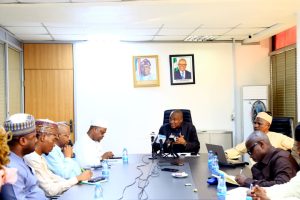
At a high-level stakeholder meeting in Abuja, the Minister of State for Industry at the Federal Ministry of Industry, Trade and Investment, Senator John Owan Enoh, said the Presidential directive banning the export of raw shea products marks a decisive shift toward industrialisation and economic value creation.
This was contained in a statement on Tuesday, 21st April, 2026, by Obilor-Duru Augustina Okechi, Head, Press and Public Relations.
Enoh stressed that the policy is aimed at building a robust processing sector capable of competing on the global stage, adding that the government will prioritise measurable results ahead of its scheduled review in February 2027.
“The gains of this policy must be clear, measurable, and undeniable before the review,” he said, noting that plans are underway to verify actual processing capacity across the country through inspections.
In his remarks, Director of the Industrial Development Department at the ministry, Muhammad Bala, said the engagement was convened to evaluate progress, address bottlenecks, and secure commitments from key players in the shea value chain.
Bala described the meeting as critical to improving coordination and strengthening Nigeria’s position in upcoming global industry engagements.
Industry stakeholders also weighed in on the policy’s impact.
Managing Director of Salid Agriculture Limited, Alhaji Ali Saidu, disclosed that processors have begun a data-driven assessment of the export ban’s effects to guide future decisions.
He identified insecurity and smuggling as major challenges limiting access to shea nuts but noted that recent government measures have helped stabilise prices and improve competitiveness.
Also speaking, Director of Group Corporate Affairs, Alhaji Sadiq Kassim, called for stronger collaboration among West African countries to curb the export of raw shea and promote value addition.
He urged Nigeria to move beyond primary processing into refining and higher-value production, leveraging its status as the world’s largest producer to attract investment and lead the global shea market.
Stakeholders at the meeting agreed that sustained growth in the sector will depend on expanding processing capacity, boosting investment, and ensuring tangible value addition.
The Federal Government reiterated its commitment to policies aimed at positioning Nigeria as a dominant force in the global shea industry.