
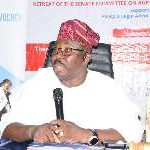
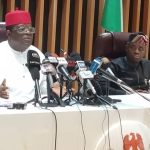
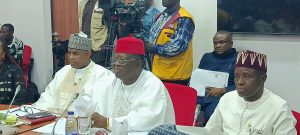
Minister of Works, Senator David Nweze Umahi, on Wednesday mounted a robust defence of the Federal Ministry of Works’ proposed ₦3.244 trillion capital budget for 2026. He emphasised that Nigeria’s road sector is undergoing a structural overhaul driven by durability, economic corridors and long-term national interest.
Appearing before the Joint Senate and House of Representatives Committees on Works at the National Assembly, Umahi outlined the scale of inherited liabilities, escalating project costs, and the administration’s funding strategy for ongoing and flagship highway projects.
The Minister disclosed that as of May 29, 2023, when President Bola Ahmed Tinubu assumed office, the administration inherited 2,064 ongoing road projects valued at about ₦13 trillion.
He explained that following the removal of fuel subsidy and the floating of the naira, construction costs rose sharply, pushing the total value of ongoing projects to approximately ₦16.9 trillion as of December 2025, excluding the President’s legacy projects and private tax credit schemes.
“It is impossible to complete ₦16.9 trillion worth of projects in one budget cycle,” Umahi told lawmakers. “What we have done is re-scoping, re-phasing and prioritisation.”
According to him, the Ministry has adopted a structured approach that focuses on economic corridors and high-impact roads rather than spreading resources thinly across numerous small projects.
On the performance of the 2025 budget, Umahi revealed that capital releases so far stood at ₦210.318 billion, representing roughly 9.7 per cent performance.
However, he noted that certified contractor claims for works executed between 2024 and 2025 amounted to about ₦2.2 trillion, highlighting a significant funding gap.
He informed the committees that President Tinubu had constituted a committee chaired by the Vice President to review liabilities across Ministries, Departments and Agencies (MDAs), including those in the works sector.
Umahi also confirmed that the Nigerian National Petroleum Company (NNPC) had withdrawn from certain tax credit-funded road projects, creating an estimated ₦7 trillion funding gap now being managed by the Ministry.
Defending the ₦3.244 trillion capital proposal for 2026, the Minister explained that about 70 per cent of the 2025 allocation — approximately ₦1.687 trillion — is being rolled over into 2026 to sustain ongoing projects.
In addition, ₦797 billion in special presidential funding has been distributed across the six geopolitical zones to support priority corridors, including:
₦160 billion for the South-West
₦120 billion for the South-South
₦105 billion for the South-East
₦120 billion for the North-West
₦105.2 billion for the North-East
Umahi insisted that the allocations were driven by economic and traffic considerations rather than political balancing.
“As lawmakers and ministers, we should think about our nation,” he said, dismissing suggestions that zonal spreads were politically motivated.
A significant portion of the presentation focused on President Tinubu’s four flagship legacy projects, which Umahi described as “investment projects” rather than conventional road contracts.
Umahi explained that under the financing model for the legacy corridors, the Federal Government provides 30 per cent counterpart funding while syndicated loans cover 70 per cent at interest rates below six per cent.
“These are not just road projects; they are investment projects,” he said, arguing that the corridors would unlock trade, agriculture, solid minerals and regional integration.
A major plank of the Minister’s defence was the administration’s shift from asphalt to concrete pavement on key highways.
He told lawmakers that President Tinubu had personally directed the adoption of concrete on strategic corridors for durability, stressing that concrete roads could last between 50 and 100 years when properly executed.
Citing the Abuja–Kaduna–Zaria–Kano corridor, Umahi disclosed that:
“Section One (180km), valued at ₦252 billion, has received 15 per cent payment and is nearing commissioning. Section Two (104km), valued at ₦502 billion, has received 50 per cent payment and is targeted for completion by November. Tell me in the history of this country, apart from Hitech, any contractor that completed 180 kilometres in 12 months?” he asked.
He maintained that the Ministry is strictly monitoring specifications and quality control, insisting that durability and lifecycle cost are now central to Nigeria’s road construction philosophy.
Responding to concerns about road longevity, Umahi assured lawmakers that weighbridges would be reintroduced under the Highway Development and Management Initiative (HDMI) to control axle loads and protect federal highways from premature deterioration.
“Yes, the weighbridges — we are going to approve it,” he said, explaining that structured private-sector participation would support enforcement and sustainability.
Throughout the session, Umahi framed the 2026 proposal as a balancing act between inherited obligations, new strategic investments and fiscal realities.
With ₦16.9 trillion in ongoing commitments and rising construction costs, the Minister argued that the ₦3.244 trillion request represents a pragmatic attempt to prevent project abandonment while advancing transformative corridors.
“There is no better representation of the vision of the President than the President himself,” Umahi said, reiterating that the Ministry’s direction reflects a deliberate national development agenda.
As scrutiny of the estimates continues in subsequent sittings, the 2026 budget defence underscored the scale of ambition and pressure surrounding Nigeria’s road sector — where engineering choices, financing models and political accountability now intersect in one of the largest infrastructure programmes in recent history.
Abuja Times reports that the session became rowdy as the Committee chairman, Senator Rufai Hanga, representing Kano central senatorial and Senator Peter Onyekachi Nwebonyi, representing Ebonyi North Senatorial District engaged themselves in a shouting-match.
Senator Hanga had accused the Ebonyi Senator of politicking for lavishing praises on the Minister rather than asking him questions during the budget defence session.